


TL;DR
- Founders usually weigh sales activation, which captures demand that exists today, against brand building, which builds preference among buyers who are not yet ready to buy. Both contribute to market share, and the balance matters.
- B2B buying tends to happen in two stages. Selection before contact and validation after. The aim is to be a pre-contact favourite.
- Channel use matures across five stages, and most businesses sit at different stages on different channels.
- Five advertising-effectiveness principles can inform your channel strategy alongside evidence about your buyers, commercial objectives, and resources.
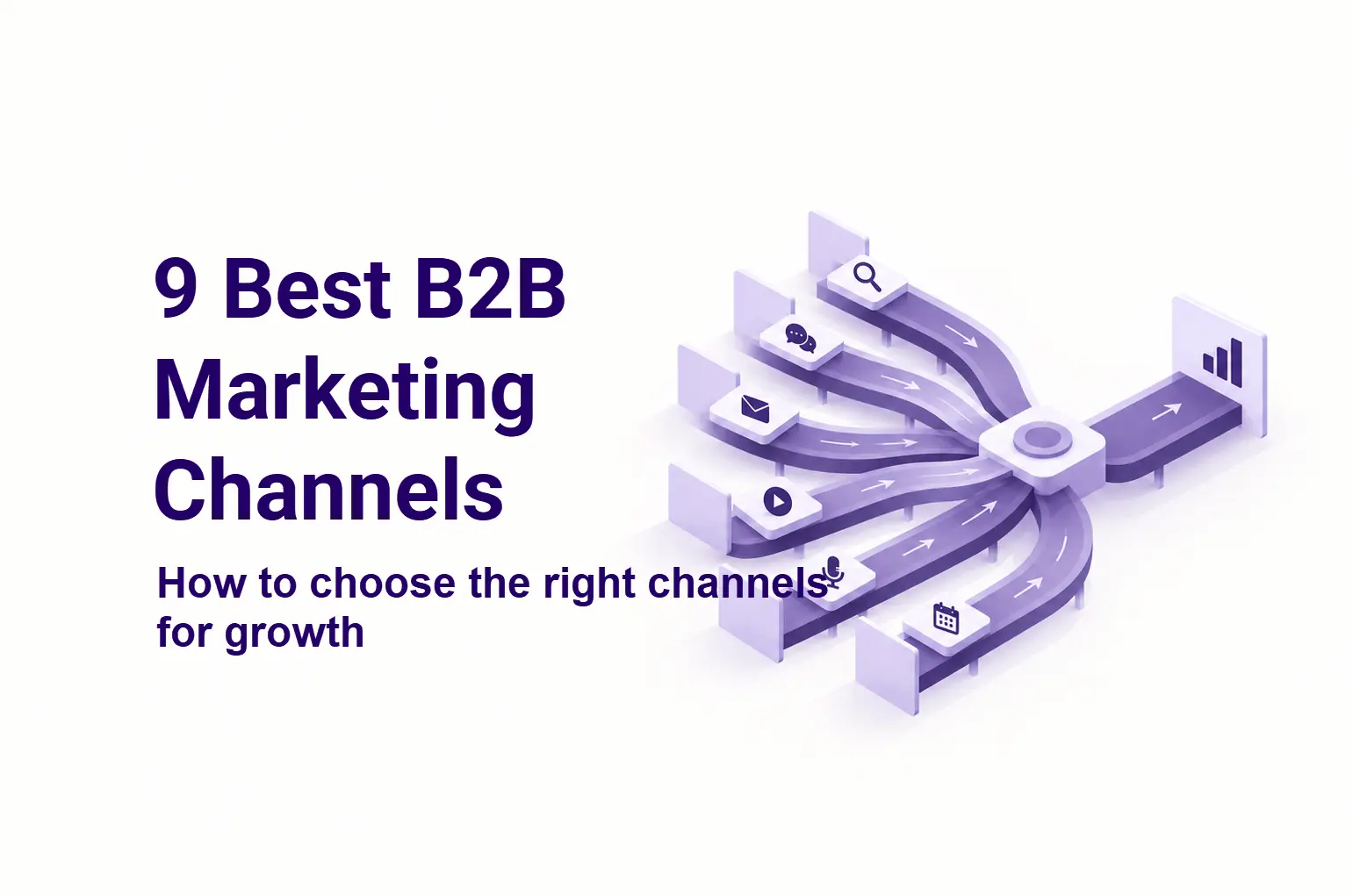
- These nine channels and content approaches can support discovery, evaluation, and conversion. Their priority depends on your buyers, commercial model, and available resources.
- The constraint is rarely a lack of channels. It is usually measurement, resources, ownership, and strategy.
When founders think about where to put marketing effort, they need to balance two priorities. Sales activation captures demand that already exists, from buyers who are in the market now. Brand building develops familiarity and preference among buyers who are not yet ready to purchase. Both contribute to market share, but they work over different timescales and are judged by different measures. Activation tends to win by default, because its results are easier to see. Leads arrive, and the pipeline moves within the quarter. Brand building is slower and harder to attribute, so it is often the first thing deferred when targets tighten. That is a reasonable instinct, but it is an incomplete one, because activation only reaches the buyers who happen to be in the market today.
Most B2B buyers now move through a mix of digital channels before they speak to anyone, so much of the decision is formed before your sales team is involved. Your business has to show up differently on each of those channels, in a way that helps the buyer validate what they have heard and reduces the perceived risk of choosing you.
That reflects two stages in the buying process. In the selection stage and before contacting any suppliers, buyers often build a shortlist of businesses they already know and trust. In the validation stage, they test that shortlist against peers, reviews, content, and sales conversations. The 6sense 2025 Buyer Experience Report found that buyers chose a vendor from their Day One shortlist 95% of the time. Their preferred vendor before seller contact ultimately won 77% of the time. For a founder, the implication is uncomfortable. By the time a buyer fills in a form or books a call, the shortlist has usually been set.
Most businesses are further ahead with some channels than others. The model below is a working framework for founders, not an industry standard.
- Exploratory means ad hoc use with no shared plan.
- Developing means owners and calendars exist, but measurement is activity based.
- Established means planned around the buyer journey with shared metrics.
- Advanced means channels are connected and testing is routine.
- Outstanding means one buyer-led system, optimised for pipeline and category presence.
Disclaimer: Not every channel needs to reach the final stage. Assess its strategic role, audience relevance, cost, and performance over an appropriate timeframe before deciding whether to invest further, maintain, or stop.
| Channel | Exploratory | Developing | Established | Advanced | Outstanding |
| Social media | Occasional company posts | Regular calendar, mostly promotional | Company and leader voices, clear point of view | Social listening informs content and targeting | Employee advocacy and community, measured on pipeline influence |
| SEO + AEO/GEO | Basic on page, no keyword plan | Keyword-led blog, limited structure | Topic clusters, technical health managed | Content built to be cited in AI answers | Visibility tracked across search and AI engines |
| Paid search | Ad hoc campaigns, no strategy in place | Some commercial terms, click-based reporting | Intent tiers, matched landing pages | Qualified-opportunity data informs targeting, testing, and budget decisions | Bidding tied to revenue data |
| Content marketing | Ad hoc blogs | Planned, produced in silos | Built on ICP and message, repurposed | Original research, tested and repurposed across channels | System serving every buying-group role |
| One list, occasional blasts | Basic segments | Role and stage nurture | Behaviour-triggered sequences | Personalised across channels, shared with sales | |
| Programmatic display | One-off usage with no clearly defined goals | Retargeting only | Account-list targeting | Category-wide reach, creative testing | Reach, brand lift, and pipeline measured together |
| Events | Occasional attendance | Sponsorship, little follow up | Event sponsors or partners with a clear role | Event content reused, linked to account targeting | Programme spanning the buying journey |
| Video | Occasional demo | Library with no plan | Series by funnel stage | Clips cut from long-form videos, distributed natively | Woven into every stage of the journey |
| Podcasting | Occasional guest appearances, no clear agenda | Regular guest spots on shows buyers listen to | A short test season with a clear premise, ongoing guest spots | Repeatable guest appearances, partnerships, sponsorships, or an owned show, supported by a sustainable plan | Regular show as an option, podcast activity integrated with wider content and relationship-building, measured against its agreed objectives |
Binet and Field’s B2B advertising research provides useful principles for balancing brand building and activation. Apply them alongside evidence about your buyers, commercial model, and available resources.
Five principles that should shape your B2B marketing channels
- Invest in a share of voice. Share of voice (SoV) is your share of category advertising spend or exposure, measured on a consistent basis. Binet and Field suggest that B2B brands that invest in SOV above their share of market (SOM) have a higher chance of growth.
- Balance brand and activation. The Binet and Field study suggests approximately 46% brand building and 54% activation. Treat this as a research benchmark rather than a fixed allocation for every B2B business.
- Expand your customer base. Binet and Field’s research favours advertising that reaches new category buyers over loyalty-only campaigns. Retention and expansion should still remain part of your wider revenue strategy.
- Build mental availability. Mental availability is the likelihood that a buyer thinks of you when the buying need arises. Campaigns that increase your share of mind tend to perform best, and the more famous they make you, the better the commercial output.
- Use emotion. B2B decisions are made by people who carry personal risk if the choice goes wrong. Emotional campaigns tend to be more effective, particularly over the long term. Your objective as a founder is to associate your business with trust and confidence.
The same message lands differently as a search result, a 60-second LinkedIn clip, and a roundtable. So the way you treat your format should be part of the strategy.
The nine B2B marketing channels and how to use each
This is a practical shortlist rather than an exhaustive ranking. Partnerships, referrals, communities, review platforms, and trade media may also deserve priority where they influence your buyers.
1. Social media marketing
Best for
Awareness, credibility, and staying visible to buyers who are not yet in the market.
Social is often where buyers form their first impression of your business. They may return as they consider their options, looking at your team, what you share and whether it gives them confidence in your expertise.
How to use
Choose platforms based on where your buyers research and engage. LinkedIn can support professional visibility through company, founder, employee, and paid activity. Give each selected platform a clear purpose. Lead with a point of view rather than promotion. When founder and employee voices are aligned, there is a coherent message that runs seamlessly across each channel. Build participation across the team so visibility and credibility do not depend on the founder alone.
Constraint
Platform algorithms influence reach, and consistent posting requires time and ownership.
Measurement
Track engagement from ideal customer profile (ICP) accounts, lift in branded search and direct traffic, and pipeline influence from self-reported attribution (what buyers say influenced them), rather than impressions or likes.
2. SEO + AEO/GEO
Best for
Being found and being cited at the time of buyer research.
SEO improves organic discoverability. AEO focuses on making information useful for direct answers, while GEO focuses on visibility in generative AI responses. These approaches overlap, and inclusion is not guaranteed. The shift is measurable. G2’s 2026 AI Search Insight Report found that 51% of B2B software buyers now start research with an AI chatbot more often than Google.
How to use
Answer specific questions directly, build depth on the topics you want to own, publish original data, and earn third-party mentions that AI tools can draw on.
Constraint
It compounds slowly, and AI-generated answers can resolve a query without sending a visit.
Measurement
Track rankings and organic traffic for your priority topics, citations and mentions in AI answers, and contact or demo requests from organic visits.
3. Paid search
Best for
Capturing active demand quickly.
Paid search uses pay-per-click (PPC) advertising which puts you in front of buyers using commercial-intent terms, which makes it a useful activation channel when relevant search demand and viable acquisition economics exist.
How to use
Pair it with SEO, match landing pages to search intent, test whether bidding on your brand terms adds incremental value and report on the pipeline created rather than clicks.
Constraint
Paid traffic depends on continued spend. Competition can increase costs, and relevant search volume can limit scale.
Measurement
Track cost per qualified opportunity and pipeline created, split by brand and non-brand terms.
4. Content marketing
Best for
Building trust and giving every other channel something worth sharing.
Content is a strategy that runs across channels more than a channel in itself. Effective content starts with a clear ICP, consistent messaging, a distinct point of view, and credible evidence. Build content around the questions buyers need answered to progress.
How to use
Agree on your ICP, build content for each channel around a few core themes, and share interesting case studies or insights derived from your own business use cases. Analyse it based on ICP engagement and pipeline influence rather than traffic.
Constraint
It needs genuine expertise and steady output. Generic content doesn’t build trust, and results take time to show.
Measurement
Track engagement from ICP accounts, content-assisted pipeline, and how often sales uses the content in live deals.
5. Email marketing
Best for
Nurturing prospects and supporting customer adoption, renewal, and expansion.
Research published by Gartner in 2025 found that 73% of B2B buyers actively avoid suppliers that send irrelevant outreach. This reinforces the importance of relevance across supplier communications.
How to use
Separate prospect nurture from customer communications, with messages tied to onboarding milestones, adoption needs, and renewal decisions.
Constraint
Results depend on list quality, and outreach to new contacts must meet UK data protection and email marketing rules (UK GDPR and PECR), so check your lawful basis.
Measurement
Track reply rate, meetings booked, and pipeline per sequence, with unsubscribe and spam-complaint rates as a channel health check.
6. Programmatic display advertising
Best for
Broad reach and repeated presence amongst buyers in your category.
Programmatic buys display placements automatically, based on the audience you define. Its value is rarely last-click conversion. It keeps your brand in front of buyers who are not yet in the market.
How to use
Prioritise display advertising when relevant. Target using account lists or firmographic criteria, cap frequency, invest in creative, and measure brand search and pipeline influence.
Constraint
Display needs a defined audience, strong creative, and enough budget to reach buyers at a useful frequency. Its effects are slow and hard to attribute.
Measurement
Track reach and frequency among target accounts, alongside changes in branded search and direct traffic. Where feasible, use a controlled holdout test (keeping a comparable group out of a marketing activity so you can compare their results with those who received the ad), to estimate the incremental effect on pipeline progression.
7. Events
Best for
Validation, relationships, and reaching the full buying group.
Events, both in person and virtual, reach smaller audiences but go deeper. Bizzabo’s 2026 benchmarks report that 78% of surveyed organisers identify in-person conferences, summits, and conventions as their organisation’s most impactful marketing channel.
How to use
There are two broad formats. In person (industry shows, your own events, dinners) and virtual (webinars, live sessions). Give each format a defined purpose, follow up with attendees within days of an event, and reuse the content across other channels, depending on event size and scalability.
Constraint
Events require time and budget, particularly when held in person. Webinars and live online sessions are usually less demanding, but still need preparation and promotion. Reach is largely limited to attendees unless you record or repurpose the content.
Measurement
Track attendance from target accounts, meetings booked, cost per qualified conversation, and pipeline influence within a defined window after the event.
8. Video marketing
Best for
Explaining complex products and building familiarity at speed.
According to Wistia’s 2026 State of Video report, 81% of surveyed teams share videos on LinkedIn, compared with 76% on YouTube.
How to use
Use short clips to introduce a problem or point of view. Make demos and customer stories available whenever buyers need to assess fit, understand implementation, or validate your claims.
Constraint
Producing good video takes time, skill and budget. Poor sound, unclear messaging or an awkward delivery can undermine confidence in your business.
Measurement
Track completion rate, engagement from ICP accounts, and demo requests from viewers, with extra weight on videos that support validation.
9. Podcasting
Best for
Long-form authority and a loyal audience base.
Podcasting can build authority with listeners and relationships with invited guests. Appearing on another show and hosting prospective customers on your own show serve different purposes and should be measured separately.
Podcasts work well as a channel for repeat engagement and authority with a relevant audience that you can engage and cultivate a relationship with.
How to use
Appear as a guest on shows that your buyers listen to and share a clear point of view as a thought leader. Test the channel, and once you have a clear premise and sustainable plan, build a show with guests from within the buyer community.
Constraint
It is a heavy, ongoing commitment with a long runway, and audiences are small. Guest slots also depend on being invited.
Measurement
Track views or listens among target roles, meetings from guest appearances, and branded search lift, with pipeline traced through self-reported attribution.
Challenges founders face
| Challenge | What it looks like | What helps |
| Measuring channel effectiveness | Last-click reports hide the channels that build selection-stage preference. | Track pipeline influence, branded search, and self-reported attribution (SRA), alongside platform data. |
| Distinguishing your strategy from a competitor’s | Same channels, same claims. | Agree on the one argument you can own, then express it through a distinct point of view or format. |
| Aligning distribution with your audience | Channels chosen by habit, not buyer behaviour. | Ask recent customers and lost deals where they researched, and map the answers to buying-group roles. |
| Refining your strategy into an effective marketing plan | Plenty of activity, no sequence. | The 28-Day GTM Sprint sets the ICP, message-market fit, and a sequenced execution plan. |
| Resource constraints | Founder bandwidth is stretched, and the team is too small to manage complete channel delivery. | The Founder-Free GTM System builds operations and manages the specialists to run it. |
| Cross-department collaboration | Marketing, sales, and customer success work to different definitions. | Agree on qualification definitions, handoff rules, owners, and shared KPIs. A Fractional CMO/GTM Lead provides leadership across the three teams. |
| Tech integration | Data and tools sit in silos. | Agree on data definitions and workflow ownership before connecting tools. The Founder-Free GTM System supports the required workflows, automation, and executive reporting. |
These are complementary signals rather than proof of causation. Review them alongside opportunity quality, conversion, and revenue; use controlled tests where feasible.
The B2B marketing channels that work help you get onto buyers’ shortlists before they contact you and give them confidence to choose you as discussions progress. Each channel needs a clear role in that process.
As a founder, your job is to decide which channels deserve investment, what each needs to achieve and which to develop first. Focus on doing a few well, with the time and resources to make them effective. Being present on more channels is not an achievement in itself.
If you’re unsure whether you need different channels, more capacity to deliver or clearer marketing direction, book a call. We’ll discuss what’s holding you back and what needs to change before you commit more time and budget.